Why It’s Totally OK if Your Freshman Roommate Isn’t Your Best Friend, According to a Former RA
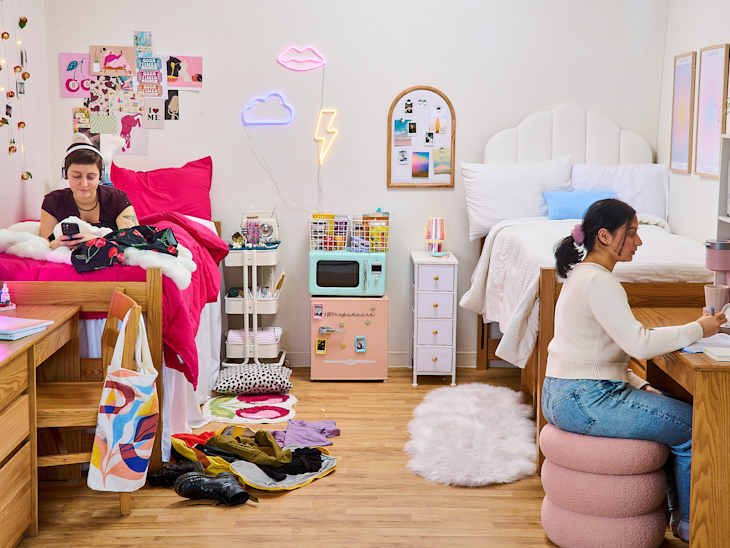
Living with an assigned roommate in your freshman dorm is a quintessential college experience. You might have big dreams of getting a built-in bestie, but some pairs are better meant to peacefully co-exist, which can be hard to accept if you had different expectations. I was an RA for three years in college, so I’ve seen just about every kind of roommate relationship play out — and I know you don’t need to be BFFs for it to work.
I’ve even had my own share of random roommates in suites, so I know firsthand that not every pairing turns into a close friendship. And that’s OK! The goal isn’t to be best friends (that’s great if it happens!); it’s to create a peaceful, respectful space where both of you can feel at home.
If you’re nervous about navigating this new living situation, here’s my best advice to help you figure out a roommate routine that works for both of you.
Start with a roommate agreement (yes, really).
If you want a good chance to at least be friendly with your roommate, start here. In a lot of dorms, RAs actually have roommates fill out “roommate agreements.” It sounds a little formal, but it’s basically just writing down your expectations so you’re on the same page. You should talk about things like:
- What time you each usually go to bed
- How you each feel about having overnight guests
- What your room policy for having visitors will be
- What constitutes a “clean” room for each of you
- Each of your pet peeves
- Each of your likes and dislikes
Think of it as getting to know the person you’ll be sharing space with for the next 10 months. And honestly, a roommate agreement works later on if you end up in an off-campus apartment with friends. I’ve seen it as an RA: The roommates who have in-depth chats about their habits early on usually avoid the big blow-ups later.
Be a respectful roommate.
Being best friends with your roommate is great, but it’s not the reality in every case. What really matters is respect. As long as you’re communicating and treating each other with basic kindness, your dorm will feel like a space you both actually want to come back to.
Your roommate agreement won’t be an exhaustive document, so it’s important to remember that manners and common sense go a long way. Don’t be the roommate who leaves food containers out for days or who plays music on blast while someone’s clearly studying. You each have separate sides of the room, but in a small space, the overall vibe or state of the room is always shared.
Always give a heads-up before having people over.
If you’re planning to have friends over to hang out in your room for a while, ask first! Yes, every time, even if you think your roommate won’t care. A simple, “Hey, are you good with me having people over tonight?” includes your roommate in the decision of who can spend time in this shared space.
If the answer is no, respect it. Even if every visitor you want to have over isn’t a “yes” from your roommate, you set the tone for open communication and make what could feel like difficult conversations a lot easier.

Invite your roommate to hang, but don’t pressure them.
Anytime you’ve got something going on in the room, whether it’s a couple of friends hanging out, or even just ordering late-night food, make sure your roommate feels welcome (after you get their OK, of course). Saying something like, “We’re getting pizza if you want in,” or, “We’re watching a movie if you feel like hanging out, no pressure,” keeps it casual.
Just extending an invitation shows effort. Even if they say no, the simple act of inviting them gives them the chance to be included. It can also open the door for bonding! Maybe one night they’ll decide to join, and that turns into an inside joke or a new routine. It’s a small gesture, but those things go a long way when you’re sharing a space.
Find low-pressure ways to bond.
Bonding with your roommate means finding little ways to not feel like strangers — you do live together and sleep in the same room, after all! You don’t need to feel pressure to always hang out together when you’re both in the room, but casual one-on-one hangs are great. That could be as easy as decorating your space for the holidays together or inviting them to watch your favorite cozy movie.
Check in with them when things feel off.
Living with someone means little things will come up — like a mess gets a bit out of hand or someone accidentally grabs a snack from the fridge that’s not theirs — and that’s normal. What matters is how you handle it. The worst move is to let tension sit until it explodes, or to start being passive-aggressive. Instead, talk about it with your roommate in a calm, casual way. It can be as simple as, “Hey, I feel like the room’s been getting messy, can we both try to reset it this weekend?” These kinds of check-ins show you care about your shared space, not just that you’re trying to nitpick. If you don’t know how to approach a certain situation, you can always ask your RA for some advice.
Remove the pressure to be best friends.
Roommates are one of those unpredictable parts of college you never really know what you’re going to get. Everyone is figuring it out at the same time, which means you’re not alone. The best thing you can do is give yourself some grace and extend the same to your roommate. It won’t always be perfect, but it will be an experience you’ll learn from.
From what I’ve seen as an RA, that’s the real secret. The roommate experience is less about having the perfect match and more about learning how to share space, compromise, and grow through it together. And that’s something every student goes through in their own way.