I Asked Designers How to Make My First Apartment Feel More Grown-Up, Less “Adult Dorm”
This article is part of Your *First* Apartment, a collection of stories designed to help you settle into your very first post-dorm space.
When I first stepped into my rented studio apartment in NYC in August 2025, I thought my moving struggles were over. No more scammy movers delaying my delivery by two weeks or surprising me with only the skeletal remains of my vanity — I was finally home.
Turns out, workshopping an empty space into a home was harder than I thought.
I had just finished grad school and moved to New York from Chicago. Since most of my furniture was damaged in the hands of irresponsible movers, I had no choice but to start anew. But even as I’ve collected quirky tulip lamps and surrealist art prints, and tried to fill the space with things I love, my new apartment still feels empty — temporary, even.
I decided to seek some advice from my two favorite interior designers: New York’s own king of loft decor, Loi Doan (better known as @kaerukeki with 1M followers on Instagram), and Chicago-based interior designer Leor Zlotnik (@lz_interiors on Instagram).
I gave Doan and Zlotnik each a quick synopsis of my apartment and my preferred style, and sent over a detailed floor plan, asking how to make it feel less like an adult dorm and more like a home of my own. In turn, they shared five wise pieces of advice to help my first post-grad, solo apartment have that “finished” feeling I’ve been searching for.
Define Spaces
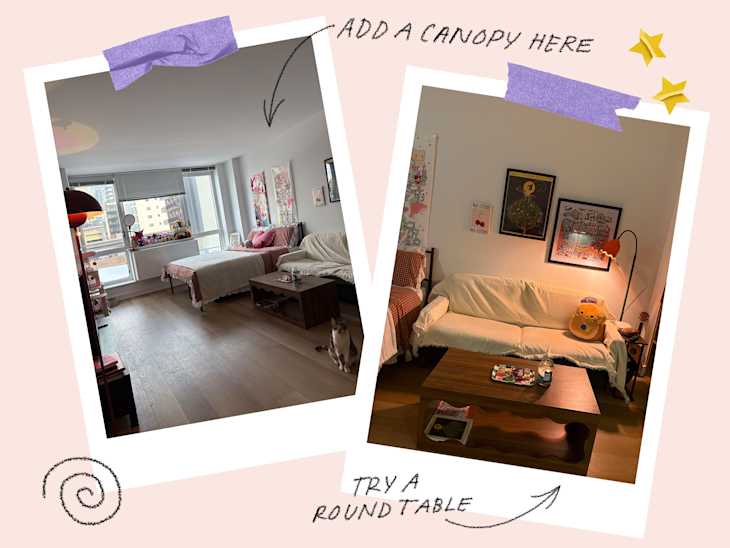
For this rectangular studio to feel truly homey, Zlotnik suggested I separate where I sleep from where I hang out. But since this north-facing studio is perpetually dim, an additional room dividing screen would trap any natural light seeping through.
Her solution: a DIY canopy bed set up by attaching Command hooks to the ceiling, from which I could hang some drapery or a sheer veil. “That contraption is maybe $50,” she says. “And it makes [your bed] look like this ethereal space.” With just one hero piece, I can build out a sanctuary for deep sleep, anchor the space, and still let light pass through.
Zlotnik says that another perk of this idea is that by fully utilizing the ceiling height, you guide the eye upward and make the space feel larger. “When you have the drapery going down, everything just looks bigger and flowier,” she says.

Ground and Balance Each Zone
I always wondered why my furniture and decor pieces never seem to form a coherent picture, despite being tightly packed together. Thankfully, it takes Doan just one look to know what’s wrong. “As of now, everything is floating a bit,” he says. “A soft cream rug beneath the couch and a coffee table will instantly tie everything together and give the impression that the space is complete.”
Additionally, he suggests that wall art should complement each area of my apartment and its vibe, rather than competing or distracting. For example, he recommends I give my TV wall some breathing room. Right now, I have a multi-headed sunset lamp radiating neon rainbows across one side of the TV and several pieces of framed wall art above it, which is diluting their impact. “Either dim [the light] so it washes just one side of the wall or lean into warm lamp lighting for a softer, calmer feel,” says Doan. “That wall should feel grounding rather than overwhelming.”
Tighten the Color Palette
According to Doan, what my studio apartment needs the most is some “editing to make it seem like this one clearly cozy story, and not two unique, cute segments.” The main issue he says is responsible for this clash? Too many colors.
Once he pointed it out, it became impossible to unsee. Berry reds and pinks dominate my sleeping nook, especially with my ever-growing collection of Sanrio plushies, whereas my lounge area (five inches from my bed, by the way) is a funky combination of cream, dark wood, bright red, and deep greens.
“[Use] blush, cream, and warm wood but with subtle touches of red and green,” Doan suggests. “Repeat those tones around the room so it feels cohesive.” Auditing and subtracting random pops of color can go a long way.
For those who need to build a perfect palette from scratch, Zlotnik recommends first pulling an anchor color either from a hero item (like, your bedspread or couch) or what can’t be changed (like your floors, millwork, or other existing finishes). Working around this base, she says she would “add two to three supporting colors [that are] either warmer or cooler versions, or quieter tones [of the anchor].” She also advocates for just one intentional pop of an accent color, a metal, or a wood tone. “Use this sparingly so it feels designed, not busy,” she says.

Layer Lighting
To give my sunless rental a little more life, both Doan and Zlotnik suggested I tweak my lighting to create a soft, natural glow throughout my space. Currently, I have a soft white LED floor lamp and a rainbow fixture bookending my TV, while a tangerine-toned tulip lamp sits next to my couch. The thing is, they’re all different tones of light and all stand around the same height. Doan recommends I stick to warmer bulbs to make the lighting throughout my studio feel a little more cohesive, and stagger the sources at different levels to keep them from competing so much.
As for exactly what kinds of lamps I need to pull off my desired cozy yet contemporary vibe, Zlotnik gave me a detailed breakdown of the three lighting types she recommends: a set of symmetrical floor lamps at eye level, some movable wireless lamps, and some hidden LED light strips.
“There are these strips you can literally attach to wherever you want,” she says, from around the undersize of my bed to lining the perimeter of my floor. This setup can create a glow without bringing in additional lamps that take up so much space, according to Zlotnik.
Play with Shape and Texture
I suspect part of the reason my studio hasn’t felt quite finished since moving in is that I live in fear of overstuffing it with furnishings, which holds me back from adding the elements that could help it feel more designed. Two factors Zlotnik and Doan suggest I can explore to create the illusion of a larger, more intentional space are texture and shape.
For instance, Zlotnik suggests that I replace my current coffee table with one that’s round, since not only can a piece with hard edges (like the rectangular one I have now) be extra annoying to bump into, but curved furniture can also help guide the eye around the room, making a space feel open and airier.
In my sleeping area, Doan recommends that I amp up the texture and dimension of my bed. “Layer on one large cream or blush pillow behind everything to allow it to feel fuller and softer,” he says. “Throw a textured blanket over one side so it appears effortless.” It’s a small change, but one that can help the area look a bit more designed, and my space more like home.